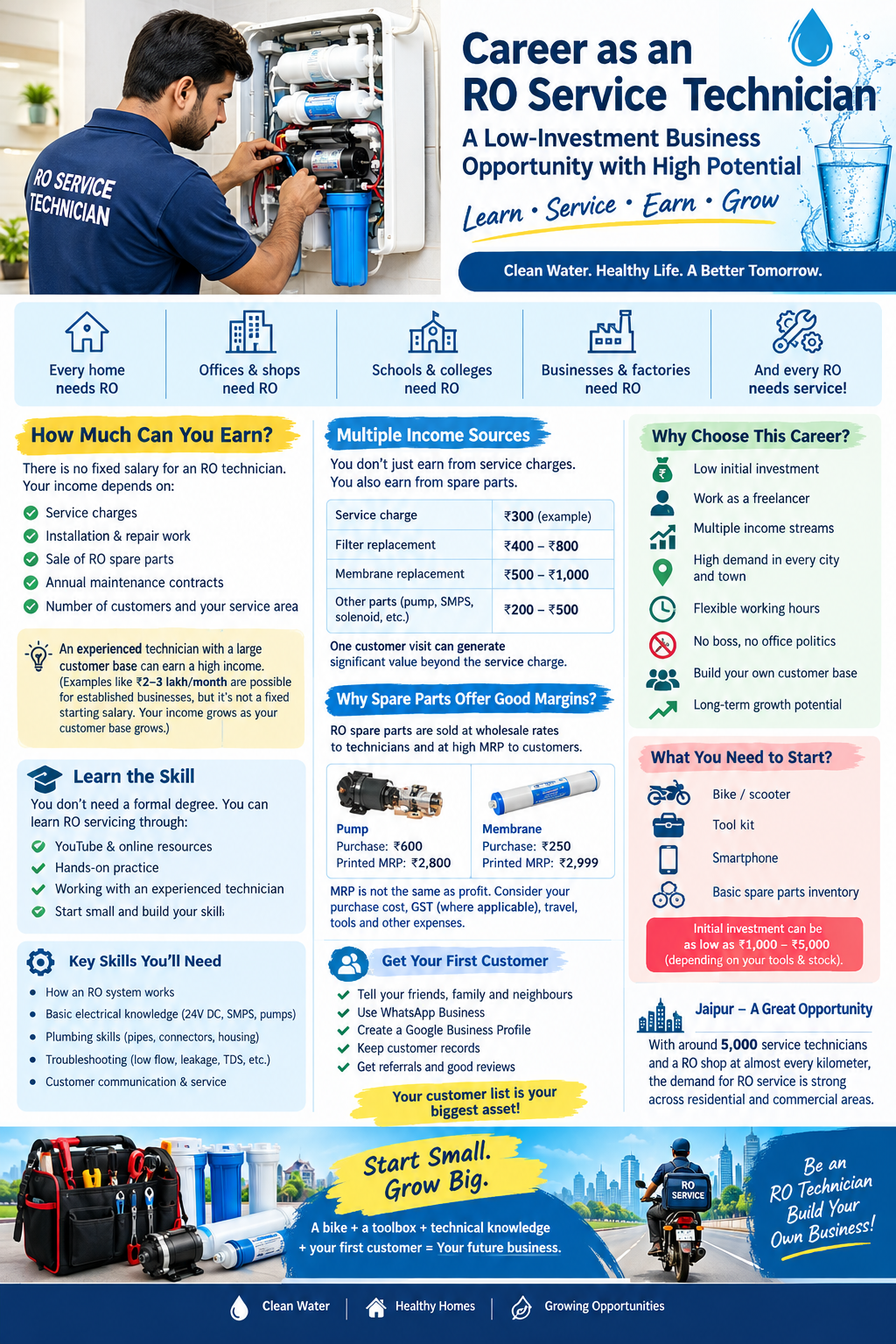
Want to Start Your Own Business with a Small Investment?
The demand for drinking-water purifiers is growing rapidly across India. Almost every home, office, shop, school and commercial establishment needs an RO water purifier—and every RO purifier eventually requires servicing, replacement parts and maintenance.
This creates an interesting career opportunity for people who want to become an RO Service Technician.
Unlike a conventional job, an RO technician can work as an independent freelancer, build his own customer base and earn from multiple sources—including service charges, installation charges, repair work and the sale of RO spare parts.
The more customers you build and the more efficiently you operate your business, the greater your potential income can become.
How Much Can an RO Technician Earn?
There is no fixed salary for a self-employed RO technician.
Income depends on several factors:
- Number of customers
- Number of service calls per day
- Service charges
- Installation work
- Annual maintenance contracts
- Sale of RO spare parts
- Replacement of filters and membranes
- Pump and SMPS replacement
- RO installation and shifting
- Customer referrals
- Area and competition
- Operating expenses
An experienced technician with a large customer base can potentially generate a high monthly income, but ₹2–3 lakh per month should be considered an example of what a successful established business may achieve—not a guaranteed starting salary.
For a new technician, the realistic objective should be to build customers gradually and increase income over time.
Does an RO Technician Earn Only From Service Charges?
No.
This is one of the biggest advantages of the RO service business.
A technician can earn from both labour/service and materials or spare parts.
For example, during a service visit, a customer may require:
- Sediment filter
- Carbon filter
- RO membrane
- Pump
- SMPS
- Solenoid valve
- UV filter
- Flow restrictor
- Pipes and connectors
- Filter housing
- Faucet
- Electrical components
Therefore, one customer visit can generate income from several components.
Example
Suppose a technician visits a customer for an RO service.
He may charge:
Service charge: ₹300
And the customer may additionally require:
Filter replacement: ₹400–₹800
Membrane replacement: ₹500–₹1,000
Other parts: ₹200–₹500
The total value of the job can therefore be considerably higher than the service charge alone.
Actual prices and margins vary according to the brand, quality, location, purchase price and selling price.
Why RO Spare Parts Can Offer Attractive Margins
The RO industry has a large ecosystem of spare-parts manufacturers, distributors and wholesalers.
Some components are sold to technicians at wholesale prices and then supplied to end customers at a higher retail/service price.
For example, a component purchased by a technician for ₹600 may have a substantially higher printed MRP or retail price.
Similarly, an RO membrane purchased at a wholesale price of ₹250 may carry a much higher printed MRP.
However, MRP is not the same thing as actual market selling price or profit. A technician must consider his purchase cost, GST where applicable, transportation, warranty/replacement risk, tools, travel expenses and customer pricing before calculating his actual profit.
The important point is that spare-parts sales can become an additional source of revenue alongside service charges.
Why Do RO Companies Print High MRPs?
In the spare-parts market, you may notice very large differences between purchase prices and printed MRPs on some products.
This can be part of the industry’s pricing and distribution structure, where manufacturers, distributors, wholesalers, retailers and technicians operate at different levels.
But technicians should not simply look at the printed MRP and assume that the difference is pure profit.
A successful technician should instead focus on:
Wholesale purchase price → genuine product → reasonable customer price → service value → sustainable profit.
Providing genuine parts at a fair price can help build long-term customer trust.
You Don’t Need a Big Shop to Start
One of the attractive features of an RO service business is that you don’t necessarily need to start with a large showroom.
A basic setup can include:
- Motorcycle or scooter
- RO technician tool kit
- Screwdrivers
- Spanners
- TDS meter
- Multimeter
- Pipe cutter
- Drill machine
- Spare connectors
- Basic RO spare parts
- Smartphone
A person can start with a relatively small inventory and purchase additional components as the customer base grows.
With a good supplier, technicians may also be able to purchase individual components instead of making a large inventory investment.
Do You Need a Degree to Become an RO Technician?
A formal college degree is generally not what determines whether someone can learn RO servicing.
The important requirements are:
1. Practical Knowledge
Understand how an RO purifier works.
2. Basic Electrical Knowledge
Learn about:
- 24V DC systems
- SMPS
- Pumps
- Solenoid valves
- UV systems
- Wiring
- Switches and connectors
3. Plumbing Skills
Learn how to work with:
- RO pipes
- Push-fit connectors
- Filter housings
- Faucets
- Drain connections
- Water inlet connections
4. Troubleshooting
Learn to identify problems such as:
- Low water flow
- Low pressure
- Pump not working
- Continuous drain
- Water leakage
- TDS problems
- Bad taste
- No power
- UV failure
- Membrane failure
5. Customer Service
Technical knowledge is important—but customer communication is equally important.
A technician who explains the problem honestly and charges fairly can build long-term customers.
Can You Learn RO Servicing Through YouTube?
YouTube and online resources can be extremely useful for learning the fundamentals of RO systems.
You can learn about:
- RO installation
- Filter replacement
- Membrane replacement
- Pump replacement
- Electrical troubleshooting
- TDS measurement
- Flow restriction
- Leakage troubleshooting
- UV systems
- Solenoid valves
- RO circuit diagrams
However, watching videos is not a replacement for hands-on practical training.
The best approach is:
Learn → Practice → Work with an experienced technician → Start small → Build your own customers.
How Do You Get Your First RO Customer?
This is the biggest question for a new technician.
You can start with your immediate local area.
Start With People You Know
Tell:
- Friends
- Relatives
- Neighbours
- Local shopkeepers
- Offices
- Apartment residents
- Schools
- Small businesses
that you provide RO installation and service.
Use WhatsApp
Create a simple WhatsApp Business profile with:
- Your name
- Service area
- Phone number
- RO services offered
- Service charges
- Photos of your work
Google Business Profile
A local online presence can help customers searching for:
“RO service near me”
or
“RO repair near me”
find your business.
Build Customer Records
Keep the customer’s:
- Name
- Phone number
- Address
- RO brand/model
- Installation date
- Filter replacement date
- Service history
This can become extremely valuable.
A customer who calls you once can potentially become a customer for many years.
The Real Asset Is Your Customer Base
An RO technician’s biggest asset isn’t necessarily his toolbox.
It is his customer list.
Imagine building a database of 500 customers.
Then 1,000.
Then 2,000.
Then 3,000.
If customers regularly need filter replacement, servicing and repairs, the technician has an opportunity to generate repeat business.
Of course, not every customer will call every month, and customer retention varies. But a large and well-maintained customer base can create a strong foundation for a service business.
RO Technician vs Traditional Job
A traditional job generally provides a fixed salary.
An independent RO technician operates differently.
| Traditional Job | RO Service Business |
|---|---|
| Fixed salary | Income depends on business |
| Employer/boss | Independent work |
| Fixed working structure | Flexible scheduling |
| Limited earning structure | Multiple revenue sources |
| Promotion-based growth | Customer-based growth |
| Company provides customers | Technician builds customers |
| Usually limited geographic area | Can expand service area |
| Salary continues based on employment | Income depends on customers and work |
Being self-employed also means taking responsibility for your own expenses, customer acquisition, tools, transport, accounting and taxes.
What About Income Tax and GST?
This is an important point for anyone considering this career.
Being a freelancer or self-employed technician does not automatically mean that you are exempt from income tax or GST.
Income-tax liability depends on your taxable income and the applicable tax rules. The Income Tax Department specifically provides guidance for individuals earning income from business or profession.
GST registration requirements also depend on factors such as turnover, the nature and location of supplies and other applicable rules. CBIC’s current FAQ material discusses the ₹20 lakh threshold in the relevant circumstances, along with exceptions.
Therefore, technicians should maintain proper records of their income and expenses and consult a qualified tax professional when required.
Cash or UPI payments do not by themselves make business income tax-free.
How Much Money Do You Need to Start?
You don’t necessarily need to open a shop on day one.
A basic mobile-service model can start with:
Bike + tools + basic spare parts + smartphone
A person who already owns a motorcycle may be able to start with a relatively small initial investment.
For example:
Basic Starting Setup
Tools: ₹1,000–₹5,000
TDS meter/multimeter: ₹500–₹2,000
Basic spare-parts stock: ₹500–₹2,000+
Transportation: Existing bike/scooter
The exact investment depends on the quality of tools and the amount of inventory purchased.
You can gradually increase your stock as your customer base grows.
How Can a Technician Increase His Income?
Once you have regular customers, you can expand your services.
Offer:
- RO installation
- RO servicing
- Filter replacement
- Membrane replacement
- Pump replacement
- UV replacement
- SMPS replacement
- RO shifting
- Annual maintenance contracts
- Commercial RO servicing
- Water purifier cleaning
- Spare-parts sales
You can also develop relationships with local RO spare-parts wholesalers so that you can obtain genuine components at competitive prices.
Jaipur Has a Strong RO Service Ecosystem
Cities such as Jaipur have a large number of residential and commercial RO installations.
With thousands of households, offices, shops and businesses using water purifiers, there is a continuing requirement for:
Installation → Service → Filter Replacement → Repair → Maintenance → Replacement
This creates opportunities for skilled local technicians.
The opportunity becomes even stronger when a technician combines technical knowledge + customer service + digital marketing + reliable spare-parts sourcing.
Start Small. Build Customers. Grow Gradually.
You don’t need to begin with a showroom, warehouse or huge inventory.
Start with a small service area.
Get your first 10 customers.
Then 50.
Then 100.
Build your reputation.
Keep your customers’ service records.
Provide genuine parts.
Charge fairly.
Ask satisfied customers for referrals.
Over time, your customer network can become the foundation of your business.
We Can Help You Start
One of the biggest problems for a new RO technician is finding genuine spare parts at reasonable prices.
A technician may need only one pump, one membrane, one solenoid valve or one filter set.
You don’t always need to purchase large quantities.
We can help technicians access a wide range of RO spare parts at competitive prices, including individual pieces and small quantities, allowing new technicians to start without making a large inventory investment.
From pumps and membranes to filters, valves, connectors and other RO components, having a reliable supplier can make it easier to serve customers professionally.
Is RO Technician a Good Career Opportunity?
RO servicing can be an attractive self-employment opportunity for someone who enjoys technical work, customer interaction and running an independent business.
The biggest advantage is that your earning potential is not necessarily limited to a fixed salary.
You can generate revenue from:
Service + Installation + Spare Parts + Repairs + Repeat Customers + AMC
But success is not automatic.
You need to learn the technical side, develop customer trust, manage your costs, purchase genuine parts and build a reputation in your local market.
Your journey can start with something as simple as:
A bike + a toolbox + technical knowledge + your first customer.
From there, your business can grow one customer at a time.
Become an RO Service Technician. Build Your Own Customer Base. Build Your Own Business.
If you are looking for a practical self-employment opportunity with relatively low starting investment, RO servicing is a career worth exploring.
Learn the skill.
Start small.
Serve customers honestly.
Build your network.
And grow your business step by step.
The first customer is the beginning. The customer base is the business.
Important Note
Income examples in this article are illustrative. Actual earnings depend on location, customer volume, pricing, expenses, competition, skill level and business practices. Tax and GST obligations depend on the applicable laws and the individual’s/business’s circumstances. Readers should take professional tax advice for their specific situation.

